(9.1) Click-Through Rate – CTR – How to Plan Your Product Based on Keyword Data

Click-Through Rate – CTR – How to Plan Your Product Based on Keyword Data
Eazyppc welcomes you to the article ‘Click-Through Rate – CTR – How to Plan Your Product Based on Keyword Data’ – you should read and thoroughly understand the previous articles, as Eazyppc uses terms and concepts explained in earlier posts throughout this one.
Articles you should be familiar with before reading this one:
- (1.1) What Are Keywords
- (2.1) Number of Competing Listings
- (3.1) Why Keyword Bid Is Important
- (3.2) Estimated Advertising Cost
- (3.3) Financial Plan for Your Product
- (5.1) Prerequisites for Ranking
- (5.2) Why You Need to Run Amazon Ads
- Article series (6.)
1/ What Is Click-Through Rate:
Click-Through Rate – is a key metric in running advertising campaigns. Through supporting Sellers, Eazyppc has observed that new Sellers often misunderstand the role of CTR and tend to optimize SEO and run ads on the wrong keywords.
-> ⚠️ Slow and steady — the damage builds over time:
- This leads to a situation where Amazon misunderstands what your product is about -> Amazon distributes your ad impressions to the wrong audience.
That said, whether CTR is high or low, what ultimately matters is sales and profit. You should not rely too heavily on CTR as a measure of advertising performance, because CTR depends on many different factors — what truly matters is your monthly revenue and profit.
CTR as defined by Amazon Ads:
- “Ratio of the number of times customers click on your advert when it is displayed. We provide you with the CTR for each campaign and each keyword. When calculating the CTR, the number of clicks is divided by the number of impressions.”
From the Amazon Advertising Report documentation:

Based on both definitions above: CTR (Click-Through Rate) is the ratio of the number of times customers click on an ad compared to the number of times that ad is shown (impressions).
-
Keyword relevance: CTR reflects how well the keyword matches the product. If the product is not relevant to the keyword or the user’s intent, even a high number of impressions will result in few clicks — leading to a low CTR. Additionally, CTR should be monitored per keyword and per keyword level (avoid drawing conclusions based on the CTR of a single campaign containing many keywords).
2/ For Products Already Running Ads
For products already running ads, Sellers can access the Ad Console in Seller Central to review and evaluate CTR. Note that CTR is calculated based on ad impressions. Therefore, CTR can vary significantly across Sponsored Product, Sponsored Brand, and Sponsored Display campaigns, because the impression volumes differ greatly.
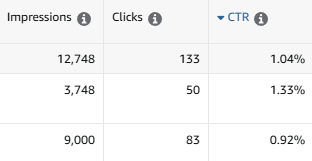
In the example above, campaign 1 is a Sponsored Product ad and campaign 2 is a Sponsored Brand ad. Depending on the product niche and the Search Volume of your core keyword set, after running ads for a period of time, you will establish a CTR Benchmark for that niche that you can use for future optimization.
3/ For Products in Research Phase
As defined above — for products already running ads, CTR is calculated as Clicks / Impressions. However, when researching a product, Eazyppc cannot yet determine the average Impressions for that niche, and therefore the impression-based CTR cannot be estimated at this stage. So when finding a product and identifying the core keyword set, Eazyppc uses the following formula: CTR* = Clicks / Search Volume. With 3 scenarios:
CTR = 0.5% (low case) – 0.75% (median case) – 1% (high case)
When building your projected business results table, create 3 projection tables based on the 3 business scenarios using the 3 rates above.
Tất cả nội dung trên blog này chỉ nhằm mục đích cung cấp thông tin và chia sẻ kinh nghiệm cá nhân về kinh doanh trên Amazon. Eazyppc.com không đảm bảo bất kỳ kết quả cụ thể nào từ việc áp dụng các chiến lược hoặc thông tin được chia sẻ.
Việc kinh doanh có thể tiềm ẩn rủi ro, và mỗi cá nhân cần tự nghiên cứu, đánh giá trước khi đưa ra quyết định. Eazyppc.com không chịu trách nhiệm đối với bất kỳ tổn thất, thiệt hại nào phát sinh từ việc áp dụng thông tin trên blog này.


Chấp thuận Điều khoản & Chính sách
Trước khi tiếp tục truy cập website Eazyppc.com, bạn vui lòng đọc và đồng ý với: