(5.1) Prerequisites for Ranking.

Prerequisites for Improving Organic Rank – Your Natural Search Position
Eazyppc welcomes you to ‘Prerequisites for Improving Organic Rank’ – you should read and be familiar with the previous posts, as Eazyppc uses terms and phrases already explained in earlier lessons for subsequent ones.
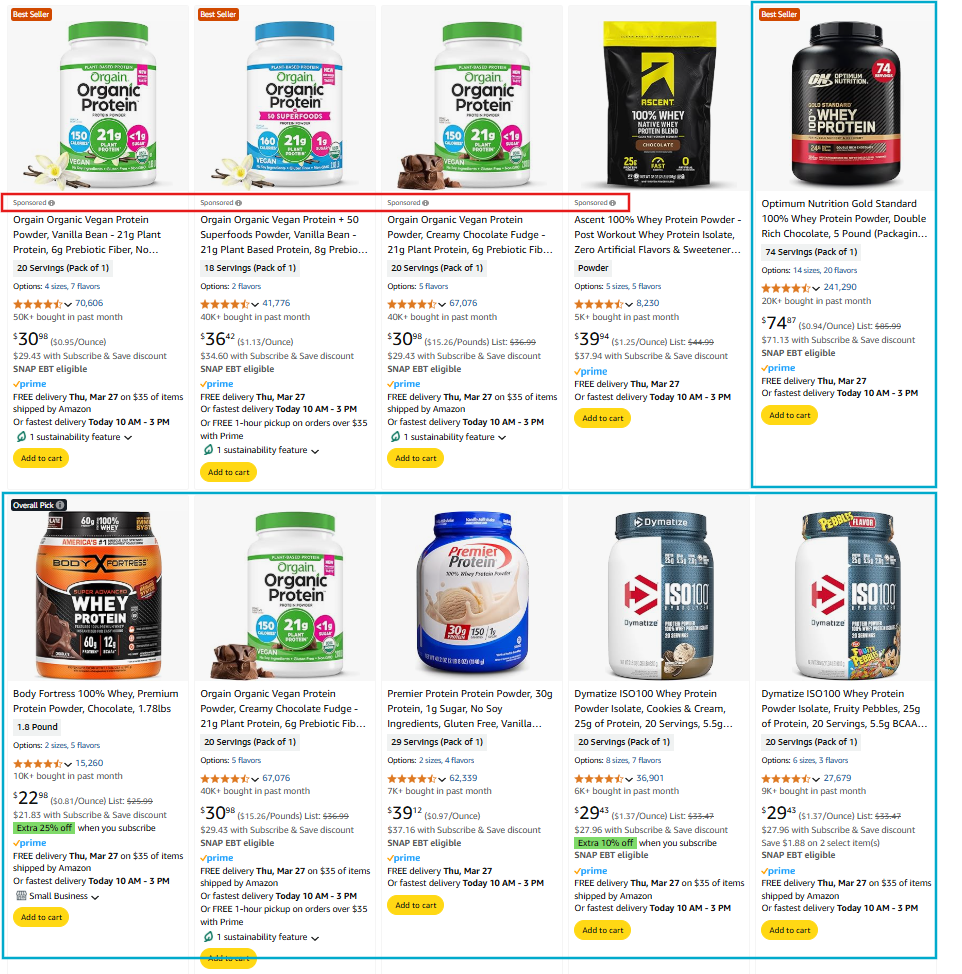
“Organic rank” -> natural search ranking: is the position where your product appears in search results without paying for advertising. This is the position Amazon assigns based on 2 factors: relevance & sales performance of the product when a user searches for a specific keyword (both factors are equally important).
Example with the keyword ‘protein powder’ on Amazon.com:
Growing your Organic Rank will bring your product:
- Increased click-through rate and clicks on your product -> Sales growth
- For example, if traffic increases from 10->20 while maintaining a 10% conversion rate, the number of orders increases from 1 ->2
- Reduced dependence on advertising budget -> Profit growth
- Because the higher a product’s Organic Rank, the more impressions and traffic it receives without advertising costs -> the better the profit margin. Therefore, the more keywords that achieve a high Organic Rank, especially keywords with large Search Volume, the more sales and better margin the product will have.
Necessary & sufficient conditions to help your product achieve a high ranking in Amazon’s organic search results (achieve high organic rank):
1/ Necessary condition:
Unlike using customer personas for ad distribution, Amazon applies PPC ad distribution based on keywords. Except for Amazon DSP: where demographic targeting plays an important role.
Each search keyword on Amazon is a “customer segment”: meaning every time a user enters a keyword, Amazon will display the products that the system considers most relevant to that search intent. This means: Keyword relevance throughout the entire listing is the first key factor that Amazon’s Bot uses to define, introduce the product to customers, and ‘index/map’ your product.
- This is also a common problem that Sellers encounter after launching a product — trying many advertising methods, A/B Testing, changing images, content, bullet points, etc., but still not seeing better results. Because when the Listing is not properly understood by Amazon, Amazon cannot correctly index the product, and may even display your product for irrelevant keywords -> wrong ‘customer segment’ -> no traffic, low CVR, and low sales.
Therefore, the necessary, mandatory condition — whether you are a Seller or Advertiser — to understand in order to push a product’s Organic Rank more easily (refer back to the Estimated Advertising Cost section, where Eazyppc guided you on how to find your core keyword set):
- Your product must truly be relevant to the keywords customers are searching for and have high Search Volume (usually fully covered in the core keyword set)
- Use the core keyword set that Eazyppc guided to do SEO for your Listing.
- Good SEO helps the product be “read and understood” correctly by Amazon’s algorithm:
- The product is prioritized for display in relevant searches. This helps the product reach precisely the “customer segments” corresponding to each keyword.
2/ Sufficient condition:
Next, Amazon uses 2 important metrics to evaluate product performance:
- Conversion Rate (CVR)
- Sales velocity in recent days
The roadmap for improving Organic Rank: Outside Top 100 → Top 100, after 1–2 weeks → Top 50, then aim for → Top 10. Each keyword is a battleground — achieving a good Organic Rank on one front can help create an advantage on another related front. Therefore, once a product’s organic ranking starts growing on the first keywords and stabilizes, it will gradually spread to other keywords (ensuring inventory stock is essential).
In practice, even when a keyword has not yet generated orders, running ads to get additional impressions and clicks can still help improve organic rank -> Amazon Bot records this as a positive signal -> thereby improving the product’s ranking in search results. However, if a Seller notices that a keyword drives a lot of traffic but does not convert into orders (e.g., 20 clicks and 1 order), they may consider lowering the bid or pausing the keyword.
From Eazyppc’s own experience, if a product’s Organic Rank has reached its ‘optimal’ position according to Amazon, increasing the bid for that keyword may not necessarily improve the Organic Rank -> because CVR and sales volume remain unchanged.
For keywords with low search volume, usually only Top-Player products capture the majority of sales -> this presents a challenge for new products. However, there is still a way to improve organic ranking position — by leveraging supporting factors such as traffic -> meaning good CTR is needed.
Tất cả nội dung trên blog này chỉ nhằm mục đích cung cấp thông tin và chia sẻ kinh nghiệm cá nhân về kinh doanh trên Amazon. Eazyppc.com không đảm bảo bất kỳ kết quả cụ thể nào từ việc áp dụng các chiến lược hoặc thông tin được chia sẻ.
Việc kinh doanh có thể tiềm ẩn rủi ro, và mỗi cá nhân cần tự nghiên cứu, đánh giá trước khi đưa ra quyết định. Eazyppc.com không chịu trách nhiệm đối với bất kỳ tổn thất, thiệt hại nào phát sinh từ việc áp dụng thông tin trên blog này.


Chấp thuận Điều khoản & Chính sách
Trước khi tiếp tục truy cập website Eazyppc.com, bạn vui lòng đọc và đồng ý với: