(9.5) How to Calculate Cost Per Order – Total Capital Required – Break-Even Point

How to Calculate Cost Per Order – Total Capital Required – Break-Even Point
Eazyppc welcomes you to the lesson ‘How to Calculate Cost Per Order and Total Capital Required’ – you should read and thoroughly understand the previous lessons, as Eazyppc uses terms and concepts explained in earlier posts throughout this one.
Prerequisite lessons to review before reading this post:
- (1.4) Types of Market Trends
- (3.2) Estimated Advertising Costs
- (3.3) Financial Plan for a Product
- (6.4) Product Characteristics & FBA Fees by Product Type
During the product research phase and before making an inventory purchase decision, experienced Amazon Sellers likely have a very clear understanding of the cost control equation. To avoid the situation where revenue is high but still cannot cover the various costs incurred when running the business, new Sellers need to be well-versed in the types of costs that Eazyppc has explained in lessons (3.1), (3.2) & (6.4).
In addition, costs can vary across different marketplaces, and all cost figures referenced by Eazyppc are benchmarked against the US marketplace. Therefore, when selling on other marketplaces, you will need to research and review the cost documentation specific to each market. Furthermore, this calculation method is best suited for Evergreen products. For Trending products, Sellers need to build separate spreadsheets for peak and off-peak seasons.
1/ Cost Calculation, Forecasting, and Data Collection Process:
Calculate estimated advertising costs -> Compile all other cost information -> Build a summary table like the one below
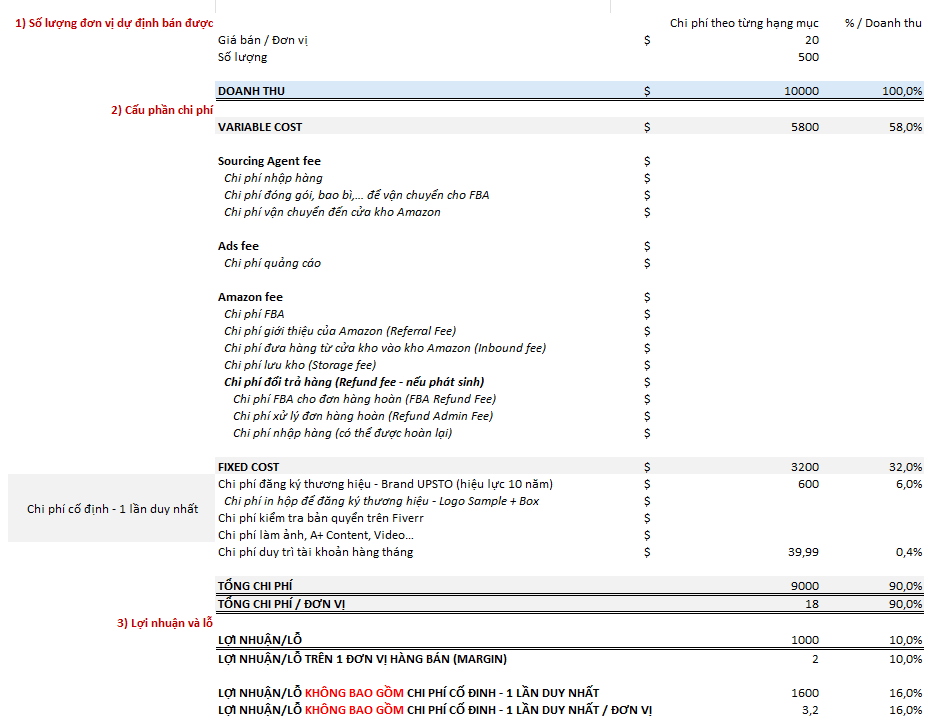
Using this spreadsheet, you can estimate total costs before making an inventory purchase decision for the first months and prepare the required amount of capital.
For example, if you want to plan and stock enough inventory to cover the first 6 months of selling, you would create 3 forecast tables — 3 scenarios for 6 months with the following adjustment levels:
- Month 3: increase price if the first 2 months sold better than expected.
- Month 3: decrease price if the first 2 months underperformed expectations.
- Month 3: keep price unchanged.
2/ Calculating the Break-Even Point:

To calculate the break-even point, Eazyppc uses the standard formula shown above. Using the example in the table, the break-even point is calculated as follows:
- Total Fixed Costs = $3,200 (including one-time fixed costs such as trademark registration, copyright checks, etc.)
- Selling Price = $20
- Variable Cost per Unit = $5,800 / 500 = $11.60
Break-Even Point = 3,200 / (20 – 11.6) = 380.95. This means you need to sell a minimum of 381 units under exactly the above scenario to break even on Fixed Costs (note: if advertising costs within the variable cost are higher than expected, more than 381 units will need to be sold to reach break-even).
Tracking the forecast table above and calculating the break-even point helps Sellers identify when any cost category exceeds projections and take corrective action (primarily in the areas of advertising costs, shipping, and unexpected legal fees).
Tất cả nội dung trên blog này chỉ nhằm mục đích cung cấp thông tin và chia sẻ kinh nghiệm cá nhân về kinh doanh trên Amazon. Eazyppc.com không đảm bảo bất kỳ kết quả cụ thể nào từ việc áp dụng các chiến lược hoặc thông tin được chia sẻ.
Việc kinh doanh có thể tiềm ẩn rủi ro, và mỗi cá nhân cần tự nghiên cứu, đánh giá trước khi đưa ra quyết định. Eazyppc.com không chịu trách nhiệm đối với bất kỳ tổn thất, thiệt hại nào phát sinh từ việc áp dụng thông tin trên blog này.


Chấp thuận Điều khoản & Chính sách
Trước khi tiếp tục truy cập website Eazyppc.com, bạn vui lòng đọc và đồng ý với: