(9.3) ACOS – Advertising Cost of Sales / Revenue – How to Plan Your Product Based on Keyword Data

ACOS – Advertising Cost of Sales / Revenue – How to Plan Your Product Based on Keyword Data
Eazyppc welcomes you to the article ‘ACOS – Advertising Cost of Sales / Revenue – How to Plan Your Product Based on Keyword Data’ – you should read and thoroughly understand the previous articles, as Eazyppc uses terms and concepts that have already been explained in earlier lessons.
Articles you should be familiar with before reading this one:
1/ What Is ACOS – Advertising Cost of Sales / Revenue
First, Eazyppc would like to use Amazon‘s definition of ACOS to explain this metric:
- ACOS (Advertising Cost of Sales) is calculated by dividing total advertising spend by total sales revenue generated from the advertising campaign. -> The general goal is to achieve a low ACOS to maximize profit.

In theory, ACOS is a metric that represents the return on investment in advertising. When ACOS is lower, it means the cost per advertising order is lower, resulting in higher profit per advertising order. From this perspective, sellers need to control or adjust ACOS to achieve the desired net advertising efficiency.
Eazyppc has provided a guide on how to estimate ACOS for a product before sourcing inventory.
2/ The Real Role of ACOS – The Growth Paradox
However, when considering operational reality and growth strategy, ACOS does not reflect the full picture — over-focusing on a low ACOS will actually hold back revenue and profit growth.
- ACOS is a metric that can be proactively controlled (‘proactive control’), but it does not comprehensively reflect the full revenue and profit picture
A product can achieve a very low ACOS if the core keyword set for the product has high search volume, but with an extremely low bid and a small budget. However, this approach is not suitable for products that need to scale, grow sales, and increase profit.
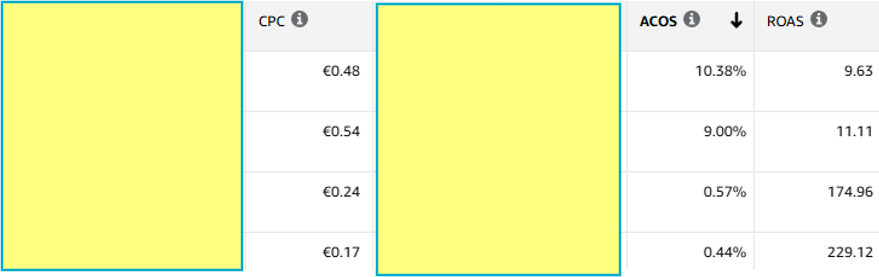
The illustrative example in this image shows, for the same keyword:
- At €0.48 CPC, only 10.38% ACOS is achieved but with 200 orders
- At €0.17 CPC, 0.44% ACOS is achieved but with only 2 orders
-> The better choice is clearly €0.48 CPC.
A seller can set an extremely low ad bid and still generate orders (for various reasons: other sellers run out of budget at end of day, etc.) -> resulting in a very low ACOS with good margin per order. The prerequisite is that the keyword has high Search Volume -> high traffic -> low bid -> ads can still capture a small portion of traffic and generate revenue. This approach suits sellers with a limited advertising budget or those reducing sales to preserve inventory while waiting to restock. It only delivers a small number of orders relative to the full potential of the product category.
3/ The Growth Paradox.
The essence of the growth paradox lies in the fact that a low ACOS does not fully reflect the long-term profit picture. New sellers often focus only on ACOS without paying attention to organic revenue, which comes from organic traffic. Therefore, when ACOS is already good, sellers want to scale and boost revenue by increasing bids and ramping up advertising. But the results fall short of expectations — ACOS spikes while revenue doesn’t grow proportionally, and profit drops sharply. The seller then reduces bids, cuts advertising -> The cycle repeats
Focusing solely on ACOS can lead to limitations in traffic and revenue. When prioritizing scaling the business, it requires advertising investment at a higher ACOS level, especially when needing to increase product visibility, reach more customers, and drive growth to capture high organic ranking positions. Therefore, in practice, the metric sellers should focus on more is TACOS.
Tất cả nội dung trên blog này chỉ nhằm mục đích cung cấp thông tin và chia sẻ kinh nghiệm cá nhân về kinh doanh trên Amazon. Eazyppc.com không đảm bảo bất kỳ kết quả cụ thể nào từ việc áp dụng các chiến lược hoặc thông tin được chia sẻ.
Việc kinh doanh có thể tiềm ẩn rủi ro, và mỗi cá nhân cần tự nghiên cứu, đánh giá trước khi đưa ra quyết định. Eazyppc.com không chịu trách nhiệm đối với bất kỳ tổn thất, thiệt hại nào phát sinh từ việc áp dụng thông tin trên blog này.


Chấp thuận Điều khoản & Chính sách
Trước khi tiếp tục truy cập website Eazyppc.com, bạn vui lòng đọc và đồng ý với: